
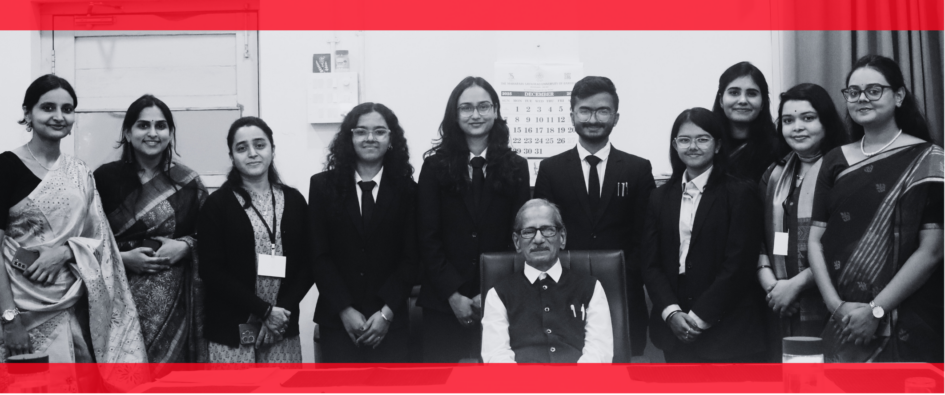
[Prof. (Dr.) M. K. Ramesh is the former Vice-Chancellor and Professor of Law at the National Law School of India University, Bengaluru. A key figure in environmental law policy development, he has assisted international bodies such as UNDP, UNEP, ADB, World Bank, IUCN, various NGOs, academic and research institutions, as well as the state and central governments of India in drafting polices and legislations.]
To talk about your academic journey, first you began with sciences and then you went to shape generations of students with different institutions like NLSIU and beyond. Now, when you look back at your school and university years, could you reflect upon some instances or experiences of yours that you still remember and cherish?
It is good that you asked this question. It has helped me to turn nostalgic. I studied in government schools all throughout and I just don’t know how you can visualize a government school. My father was an engineer by profession and he always used to get posted to places where there was construction work as he was an electrical engineer. Power generation was the first stage of a township development. So, there would be no township at all. It would be a project site, and in those project sites we used to have government schools. A government school would have asbestos sheets for a roof and zinc sheets for walls. I distinctly remember my third year class. On the first three rows in that third year class, we had planks on which students who come early would sit, and those who come late would have to sit on the floor. Just in front of it, there was a third year class board. Just opposite that there was another board with the same three-four planks and empty space. That was the fourth year class.
It was not just the convergence of different entities; it was actually the convergence of classes with one teacher to manage both the classes. And each one of us in the third year or fourth year were just like frogs in the well. How he managed us! An outstanding teacher! I have not seen the likes of him in my life. In fact, that was my first impression. If you want to become a teacher, you should become like him. When he was teaching the third year class, the fourth year class had an assignment to do. So, they could not make any noise or disturb us. Similarly when he was teaching the fourth year class, the third year class would be in attention, doing their assignment. The result was that I had the double advantage. The advantage of learning, not only my third year class but also the fourth year class while doing third year.
As luck would have it, my result was announced last. There they used to announce it on the blackboard. My name or number was not there on the blackboard and the teacher said, “You have failed, so you go home.” I was not unhappy or crestfallen because I was, I think, a six-year old then. Whenever children make a lot of noise at home at the age of three, they would push you to the school. I was one such. So, I did not know about passing or failing or anything. I just came home. My only fear was what my father would feel. He was such a notable figure in the society and this fellow is a third-year-failed boy. To cut a long story short, it so happened that the teacher did not reveal my results because I would become complacent. He conveyed it to my sister, an elder sister who in turn conveyed it to my father and they wanted to play this drama. So, I came home like a very guilty party not knowing what to do. My father summoned me. I always used to greet him whenever he would come from the office but I was the last one to receive him because I knew that I would get brickbats. Surprisingly, my father said, “What happened to your result?” I said, “I failed.” He said, “No, you fellow, you got a double promotion. It appears you knew everything in the fourth year class and the teacher has given you a double promotion.” See, here was a teacher who not only taught you well, but also taught you the primary lessons of humility; not to get carried away by whatever success.
In fact, I distinctly remember something even while in the third year class. Whenever the headmaster would call, the class would be in chaos. What the teacher would do is, he would give a problem to the fourth year students, and give some assignment to the third year students to do. He would calculate the time left and he would be gone to the headmaster’s office. He would tell one of us to engage the others. It so happened that he used to ask me to manage the fourth year class. I used to take a lot of pride. I am the teacher’s partner. I had the danda with me. In the sense that, if anybody made noise, I would note it on the board so that the teacher could take action. So everyone would listen to me and I used to feel so happy. But my ego was punctured when he told me I failed. And now as I reflect, I feel that if I learnt anything of humility, I think it came from him.
A teacher has to be like Arjuna; a Savyasachi. He was teaching us language, he was teaching us mathematics, he was teaching us social science, and he was a master in every subject.
Me getting into law was an accident, in the sense that I never thought of doing law. I am a natural science student. I studied botany, zoology, chemistry for my B.Sc. I had the highest marks in the university in English. So I had two options–either to do a Masters in botany, zoology, or English. So these were the two options open. I did not like either of them. So I went to the Dean’s office– the Dean of Student Welfare, and I told him that none of these would interest me but I would like to take the IAS exam. He asked me how old I was. I said, “I am 17 years old.” I was a B.Sc. graduate at 17. He told me, “17 is not the age where you will get admission. To take the exam you should be 21 years old. Till then you do something.” My elder brother who was standing beside me said, “Look, some new colleges have come up and they are taking admissions. Why don’t you register?” I thought it was only for a couple of years. So, it doesn’t matter.
That is how I joined law. But as luck would have it, law got into me. I got so obsessed. I thought that of all the subjects that you learn, this is the distilled wisdom of all disciplines.
[One of the interviewers remarked that she too was a student of science, and wanted to become a doctor. Then she changed her field to law.]
Actually that was my earliest obsession. I wanted to become a doctor but as it so happened that I became a doctor in law. Now I am addressing the doctor’s fraternity. That is the advantage of a lawyer. Everyone chooses science to become a doctor and this is the notion people have in 2025.
I think we should dispel this myth because I used to be the chairman of the admissions for law for well over 10 years. I used to set the paper. The thing is, in those 10 odd years of paper setting and examinations, it is the science students who have scored over all others. Although Arts appears to be closer to law, it is not. It is a misnomer and a terrible misconception that law is biased towards the arts. Of course, some of the elements like the political organization, whatever you study in social sciences in the primary school level would come in handy. But that is pure general knowledge. And general knowledge does not require an arts degree or a commerce degree. It has to come to everyone including a science student. The element of rationality that is an integral aspect of science learning is the DNA of law. A lawyer is a skeptic. And as a skeptic he questions everything. Not because he is a cynic but because of the fact that he wants to test, check, verify, ascertain, be assured that there are no lapses on his part in drawing a particular conclusion. So, scientific thinking or a scientific enquiry goes very close to rational interpretation of law by a student of law. So, that is one of the primary equipments for a lawyer–to be rational.
I always consider law as glorified common sense. Nothing more than that. We unnecessarily make too much of the law. I think we need to demystify law. If it is not glorified common sense, then it is not worth having it at all. If it does not appeal to common sense, if it does not appeal to everyone’s sense of justice, why should you have a law at all?
During the time you taught in the classrooms of NLSIU, you also created excellent centres like CEERA and Common Cells Environmental Law Clinic. You responded to the legal gap in education. What motivated you to create those centres in NLSIU?
These are all encomiums that should never come my way because I do not deserve any of that. I did not create anything. I did not do anything extraordinary about setting up centres and making them excellent. I think it was a collective effort. It just happened that I was given that opportunity. When there is a felt need, solutions would open up. I was walking in the dark and I was just groping around and looking for some light. There was just a crack in the window. I just opened it and then later I found that there is a whole world outside. I opened the door and it manifested itself.
Same is the thing with regard to my environmental law learning. As I got into law teaching after about a dozen years, when I joined NLSIU, the first question that was asked of me was, what are the subjects you teach? The director asked me what your specialization is, what you teach and what you are comfortable in teaching. I said that international law is my specialization. I can teach international law and, in my initial years, I was teaching contract law, company law, and jurisprudence. In the very first year of my teaching, I was asked to teach constitution law but I would prefer international law. He asked me, “These are your comfort zones?” I said, “Yes.” He said, “Then we will take you out of your comfort zone. You will teach environmental law.” That’s how it started.
Instead of me digging my own grave, it was already there. I had no inkling or an idea of what this subject was about. I also had to set up the curriculum. See, it is not that I was alone or I was the first one to do that. There was one gentleman by the name Armin Rosenkranz. He had come to India on a post-doctoral Fulbright fellowship. He had initiated teaching of environmental law in our law school. But I was not there at that time. The first batch of students were taught by him. Then he went back to the United States. This is what the director told me, “Armin was there earlier. He was teaching it. None of us know about environmental law. You have to do it.”
What I felt was, here is a challenge. Let me take it. One of my signature tunes has been to leap and then look. Not look before you leap. When anybody asks me to take up something out of the way, I just take it. I jump at it and then of course have a little bruise here and there and then get into that. So that’s how it started. Even in teaching environmental law, I knew that what Armin had prepared as a curriculum was perfectly fitting into the industry setting. It was more about pollution, waste management, compliance by industry, and things like that.
But somehow, as a natural science fellow, with my background, I felt that environmental law is not only this. It should be much more than that.The director had given me the liberty of designing a curriculum. That was a great thing. So what I did was, I went to an ecologist Madhav Gadgil, a professor in environmental sciences and ecology in the Indian School of Science. So I told him that this subject has been given to me. I asked him if there was anything beyond pollution control. He said, “What are you talking about? There is so much of life in the environment. So why don’t you bring a little bit of life to the environment? And that enlightened me in a way. So then I thought, if you want to really know the environment in all its splendor, you should see the environment at work. I got an academic insight from somebody like Madhav Gadgil to look beyond the law discipline and borrow from other disciplines. Then to see it working, I had to go to administration. I went to the pollution control board. I went to the Secretary of Environment. I had a chat with them and one of them was a fantastic environment secretary, very deeply learned by the name Yellappa Reddy, a great environmentalist. I brought these people to come to my class. I had a double objective. One was to set my curriculum and at the same time learn also. So it just developed over a period of time and after about four years, I had an opportunity of 50 environmental law teachers from across the globe congregating in Singapore for a one month program for the Asia-Pacific region to look into the design and development of Environmental Law pedagogy.
That was a godsent opportunity because I was all alone and I had 50 others just like me, as ignorant as I was. But I think the churning that took place there was great. I distinctly remember that, on the spur of the moment, I said that I will do a bit of a role play. Through that we can have some kind of learning of environmental law.
In this role play, I was a tribal. I was a forest dweller and somebody else was a bureaucrat. And somebody else was an expert in EIA, like that. So we went into a debate over that and it was a skit designed by me. Somehow I had a little bit of love for literature. They took it. And those very people who came together said that this is excellent material for the curriculum on environmental law; environmental law in action. So you put pieces together.
And I feel so very happy to say that the curriculum is so dynamic that the curriculum of the previous year does not remain the same as the next year. And it has been ever evolving. And just to test myself, I always used to have a senior student go with me to the class or a research staff to go with me to the class to really check whether this fellow (me) is repeating himself all the while or is he coming up with something new. So innovation just comes naturally.
Because you get tired of your monotony, students will get tired of course. But luckily for a teacher, the group changes. So this batch I have taught, the next batch, fresh. They just don’t know what this guy has said. But still you have this fellow lurking behind you, the researcher. He will be watching–the same joke, the same words you have been repeating. So they have been excellent critics of mine. That helped me.
Later, a teacher’s training program came along and I had to run it for one month to have the responsibility of both developing a curriculum and also pedagogy for the teachers all around India. And luckily I ran this for some 10 times, I think. An academic staff college program kind of thing where some 300 law teachers from all over India are trained by a national law school. In one of the programs, Shanthakumar, who is now the vice-chancellor in GNLU, was the participant. In the concluding session to that, he told me, “Teaching environmental law is not unidimensional is what we have learned from Professor Ramesh. And you have developed 16 methods of teaching environmental law.” I did not know. It just naturally developed. Adversarial method, the narrative style, the storytelling. All those were an integral aspect of my being. And being natural was something that I thought would be appropriate for teaching environmental law. So, like the Chitragupta in Yama’s kingdom, he would make a note of it and say, this is all what you did. I said, “It’s good that you have made a record of it. I forget whatever I did earlier.” So that helped me to think afresh. And then this idea of developing this into a centre grew.
It just evolved naturally. There was a demand for training in environmental law, not just for law teachers, but for people from the pollution control board, from the ministry, from the judiciary. Our judiciary made a demand. So I had to set up a centre which would actually take care of building capacity and enhancing the capacity of people who are engaged in conserving, protecting, and improving our environment at the government level.
I developed some interpretative techniques. And I’m happy that in many of the judgments of the Supreme Court, these are reflected. One example is the public trust doctrine of what Kamal Nath did in 1996. There was a sea change in it in 2002. That’s because one of my students, who went as an article clerk to Justice Agarwal in that case, took all my notes and presented them to him. And that became part of the first part of the judgement on public trust doctrine.
So you just don’t know. In the laboratory called the classroom, there are magical moments in the class, thanks to young people like you, who are very fresh and who do not have any baggage with them. They keep questioning everything. And there is a spark of light coming somewhere. And that actually helps you in becoming a better teacher. It helps you in making policy interventions. It helps you in helping a judge or drafter of a law or anything like that. So the centre developed that way.
I felt that we just do not have much of a grounding in our traditions and practices, which are far more environmentally friendly than all the modern Anglo-Saxon law. So, I thought let’s develop some of that and so I created this Commons Cell. It’s a one-man show. And as it so happened, a few people also worked with me. Bhandarkar Oriental Research Institute in Pune has a set of modules that were developed for teaching people in environmentalism or some such thing. They asked me to do a little bit on traditions. So, I did a little bit of it. I think that’s made part of a diploma program or something like that. I think it was launched some one year back. So these things just unfold. As you open a window, the door is set ajar.
So the trick lies in daring. Daring to be different. Not that you consciously do that. It unconsciously happens. And the thing is, you should not take anything for granted, either as a student or as a teacher, in law. Because the expectations of society are so great. The demands are ever increasing. So, to be relevant, you have to reinvent yourself all the while. And this was a reinvention exercise, all the while. The third one was, there is no finishing school, unlike in the western countries, where a trained and educated law student would be well-equipped to take up a particular course in practice. So I thought the Environmental Law Clinic would help. So I set it afloat. As an academic, these are the things you are supposed to do. Nothing to really crow over. It’s a natural thing that happened. And luckily, I had the environment in National Law School, which gave me all the freedom. All the liberty I demanded. I did not ask for money. I just wanted an opportunity. And I feel that this is the area, law in general, and environmental law in particular, which opens up such avenues for learning. The first time when I offered an elective course on climate law, I just had four students. But as it so happened, I redesigned the curriculum. Before the second year, I took a four-year time gap. Because I knew that there was something wrong. It was all theory, theory, theory. There was nothing on carbon credits, there was nothing on carbon financing and all that. So, I thought of introducing practical elements in it.
Then, the whole class subscribed to that course. So, once you bring in the practical element in it, the magic is done. Because every student of law or everyone who approaches law wants to know what is the practical utility of what you do. And so, it was actually a kind of a new revelation to me. I should speak the language of someone who is in need to first address his problem and then find redressal. That’s what law is about.
Regarding all environmental legislation, be it Water Act, Air Act or Environment Protection Act, it can be observed that because of fewer instances of imprisonment, the law does not have that deterrent effect. In your opinion, should there be higher fines?
It’s a fact. Basically, environmental law came as a response to a mass tragedy if you go by the Environment Protection Act background. But what has become of it, as you know, is a toothless, dangerless wonder. So, what is the use in talking about and teaching environmental law, when it cannot really perform the function it is supposed to? I think that’s where exactly the teacher’s role comes very prominently. You have to change the “is” to “ought”. Of course you have to show the reality. But at the same time you must also look into the other reality.
If you look at the way in which the Pollution Control Board or many of the Environmental Protection Agencies are functioning, they have become a kind of rent-seeking department. But that is not their design. That is not what they are meant for. It is almost like: make an application for a license. You have to pay so and so fee.
So, applying the text to the context, you will find the gap between the two. And the teacher is a kind of a reformer. So, how to find success in it? And how to make things interesting? One thing is, for your student, while you show the mirror image, you also give the other side of it. That here is a law which is imperfect in every sense. And for that, you need to infuse life in it. And that comes through interpretation. And interpretation of law, you apply all those principles of interpretation.
No court of law can challenge you. I distinctly remember an episode from 2016 which is now in the public domain. There is something called a centrally empowered committee concerning the forest. The chairman of the centrally empowered committee came to my office and he gave a voluminous judgment. He asked for my help. This was a forest royalty case, decided by the Karnataka High Court. It was a judgment wherein the the forest department was collecting tax. There is something called the CAMPA Act, 2015, whereby they impose a tax for forest conservation and other things. They have been collecting this for the last 30 to 40 years. Now, the use of the expression ‘tax’ in the state law was challenged. All students of law know that taxation is a central subject; a union subject. So it was challenged how a state can make a law on tax which would be unconstitutional. The High Court accepted it and decided that all that money that has been collected over 30 odd years should be refunded to all the mining industries. The person who came to me said that this is the plight we are in. And it is a very lengthy judgment. I said, “Please leave it with me. I am a student of law. I will first study and then come with a solution for you. Give me just two days’ time, I will burn my midnight oil, I will set everything aside and read it and come prepared. Can you meet me the day after tomorrow?” So two days hence, he came. I told him, “You have the entire law on your side. Don’t worry, you can go ahead. But for that, I need an assurance. You have two choices before you. One is an ordinance to come from the governor to explain the expression tax under the Act, that tax is not to be understood in the general sense of the term but in this particular special sense. Is it possible?” He said, “Impossible.” I said, “Then, give me an assurance that you would go up and appeal. You have three months’ time. 10 days are already gone. So, in another 2 months and 20 days, you will go up and appeal to the Supreme Court. I have prepared a brief.”
I had prepared the brief for them which was just an interpretation of the statute. Nothing more. It asked what the object of this law was. It was to conserve, protect and improve. Thus, any kind of damage, danger or harm that is done to that needs to be redressed, repaired and replenished. So, the lawmaker has used a very general expression called ‘tax’. But the real intent of the law is as a levy of thanksgiving for the one who has actually consumed this resource. The miner who has taken the resource from there is actually giving back to that resource whatever is due to turn it into a smiling garden all over again. So it is actually not even a repair cost. It is replenishment. And this is what the law conveys.
I consulted one of the former Chief Justices and told him about my brief. He said your brief is fantastic but the problem is there is no guarantee that the government would engage and advocate. Can you find a very strong NGO who would fight this case? I said I will try to find. So I found one. I don’t want to mention his name. An amazing person who had fought many a battle on forest issues said that I will take it up.
Just one week before the deadline, the government went up and appealed. Because the CEC was behind them. And you know what happened? The Supreme Court took up that case. And like in the Godavarman case, they clubbed all similar claims from all over India. The amount that was due was 25,000 crores all over India. And the judgment was the same that has been given in the draft. The point I am just trying to make here is that just because the law is bad, or just because the law does not convey its real intent in the lex scriptum, the written part of the law, you should not really feel troubled. Interpretation is all about clarifying things.
And that is what you do. So if the purpose of the law is justice, and if the purpose of that particular law is those stated objectives, you need to bring in these rules of interpretation into play. Environmental law teaching becomes an exciting subject because there are so many loopholes in the legislative law. This is exactly where your ability to understand the law and apply it to do social good comes to the fore. You may not succeed because even the judge may not accept. It happens. I just gave you one success story, but there are plenty of failures.
But there is absolutely no harm in trying. And you may succeed sometime. That’s what we do in the classroom. In the class also, you go with such hope. It happened to me once. I went to the Doon School in Dehradun. The director of the school at that time was Kanti Bajpai. He told me, “Professor, don’t go with any hope to the classroom. It’s going to be a very humbling experience for you. Because they come from very affluent families, many of them may not be interested. They don’t even listen to me. I said, “I go with zero expectation to a class for the simple reason that if the students are disturbed, I am at fault. I have not been able to communicate with them. Why should I blame them for not being interested? Why should I assume that they came interested? I should create interest in them. I have no such expectations.”
Then, he introduced me to the class. It took five to six minutes for him to introduce me. It was a one and half hour class. No one paid attention. He was very right. I had to speak to them about human rights. That was the topic given to me. So, I went and I said, “I know that you have not heard any introduction from me. Don’t worry about that. I, too, am not here to talk to you about human rights. But I just want you to know something about human left. Are you aware of that?”
See, one of the ways whereby you draw the attention of your listeners is to create an interest in them. So, I tried this. Human rights is what we have heard, but what is this human left? So, everyone was looking around. Luckily, those who were otherwise busy also started looking up towards me. But, there was one boy who was sitting at the back reading the Times of India newspaper. So, I looked at that boy and said, “Ah! That’s a wonderful starting point for me. Please, are you on page number three?” I had read that newspaper early in the morning. I said, “I know that you are on the last page; the sports page. But please turn to page three.” He turned and I said, “Anything that has something to do with human left, please read.” He replied, “I don’t know what is human left.” I checked, “Okay. Do you have the mood to listen to me as to what human left is?” They had to say yes because they were all feeling guilty at that time. So, then I started with the denied, deprived sections of society who are left out of all the benefits and then I started constructing my thesis on human rights.
So, I had a fantastic time with the students and it was more a conversation between me and them and at the end of one and a half hours, I came unscathed. I don’t say I succeeded. So, I think we need to try. Environment law won’t interest anyone, especially with the amendments that have come to the environment related laws where we have moved from the punitive regime to the compensatory regime. Moving from punitive to compensatory regime is really a welcome thing because law should not be a deterrent. Law should not be punitive. But there are exceptions, and the environment is one such exception whereby the ‘polluter pays’ principle is generally acceptable. This is because whatever is lost can be repaired, recovered, reclaimed. But not all. If a species is lost, if an ecosystem is lost, you cannot be a Vishwamitra to create a new universe, and it is lost forever. It is a cul-de-sac of life. And with the end of life there is no way you can regain that. You need to identify those areas where replacement is not possible. The compensatory regime won’t do.
Even a technician would apply different tools and instruments for different problem situations. And law confronts many problem situations where some are compensatory, many punitive, and some involve a death sentence. That’s what our criminal law talks of.
But, environmental law requires a little different treatment. I think we need to educate the law maker. We need to educate the industry. We need to really talk to them and that’s what we are meant for as teachers. When you say that there is no solution, I think we have to invent one. And that’s what we are meant for as teachers.
Sir, because you were suggesting an eco-centric approach in solving the problems of environmental concerns, we wanted to ask you if we can reimagine environmental governance in a way where we can treat nature as a person. Can we develop a different jurisprudential approach shifting from anthropocentric to ecocentric?
See, the basic problem lies in putting things in confrontation with each other. Man against animal. Man against nature or anything. I think in simplifying things that way, we derail ourselves. When I mean the ecocentric approach, we are redefining it as lawyers, not like a natural scientist or an ecologist. This ecocentric approach or the biocentric approach is not just confined to nature for nature’s sake. But my understanding, if I can place before you, is that you should never ever think of environmental law as one confronting the other. Or to put it in very simple terms, it is just like the position of amicus curiae in a court. He does not take sides. He balances both the arguments. He does the research on his own as it happened in the Godavarman case; that’s what Harish Salve did. Thus, he tries to find a meeting point whereby this could be resolved. In the case of nature or the environment, this is what is always required.
It is neither anthropocentric nor deep ecology. But it is something to consider that in taking care of and doing equity to the environment, you are doing equity to humans as well. The biocentric approach is more a holistic approach. A holistic approach considers life of every form and every kind as of some significance that should be allowed to perform its assigned role uninterruptedly. For doing that, law should be a facilitative mechanism. And in doing so, it is not favoring the humans or it is not favoring the animal. It is actually favoring what is called the goal of law–justice. That’s how I see it. And I am not speaking in abstraction. There are examples.
One such example is what you find in New Zealand where they have a natural resource management law where all departments of the government converge. The first priority is conservation, then sustainable use, and then development. You have to go in that order. What we do is we prioritize development and we pit it against conservation. That’s where exactly we commit the gravest error.
Could you tell us more about your concept of Aranya Samskriti?
See, this is a western notion. The western notion of civilized and uncivilized. The civilized ones are those who are city dwellers, citizens. Uncivilized ones are rural people. They have to be put in the forest. And that’s what the rulers used to do. If you are an outlaw, put him in the forest. Let the wildlife take care of them. So, forests are for thugs, for dacoits, and such things. We have all those Chandamama stories of dacoits populating the forest area. Don’t we have dacoits within the city?
But Indian culture, Indian civilization gives us a different kind of perspective. Civilized nature does not come from being in a sophisticated environment. It is something that comes naturally. Why does it come naturally? Because in nature and in that environment, you have tranquility. And in the tranquil atmosphere, new ideas and enlightenment would come. Our seers and rishis of the past said this. Where were they? They were in the forest. They had their gurukuls there. Royal families used to send their children to these gurukuls. And these children were educated not just in physics, chemistry, botany, zoology and law, but also in warfare. It was holistic learning. So, if you wanted holistic learning, aranya was the place. So, the most enlightening and enlightened place on earth was the forest. That was our civilization.
See, we keep talking about Indian tradition and all. It looks wonderful on paper. But we really don’t go to the very depth of it and then see what is that Indianness that we are missing now. Not that we should go to the forest now. There is no forest left or gurukulas left like those days. But, we can transform our gurukulas into that kind of a learning place where I should not be strictly compartmentalized to one discipline and then told, “Oh, now you have graduated. You have become a master. You go and practice.”
Especially in law, you need to have a little bit of an inkling or an idea about all other disciplines. You have to be a jack of all trades, but master of law. So, law is that crucible which puts all disciplines in one and the wisdom that comes out of it is law. That is the way I see it. So, Aranya Samskriti is the most evolved Samskriti. And it is only metaphorical. Of course, Tagore did not say all this. But he just actually gave us insight into the life of lore; how people lived in older times. So, Aranyaka Samskriti is not of outcasts, it is more civilized.
The theme of this edition of Vox Legis is ‘inheriting a world in turmoil’. The damage caused by war is not always immediate or visible. It often lingers in rivers, forests, and soil. So, in your view, how can law address such environmental harm which is linked to conflict? Or particularly, how does it impact victims?
I don’t think this is a question for law. This is a question for our lawmakers and policy makers. Do they really value peace? In fact, when people talk about what is there in environmental law or environment, I put the question back to them. I ask them, does the environment matter to you at all? And if it matters, how? And why? And if you have answered it, then I have my answer ready for you. Same is the thing with this. If you really need peace, at least peace for the time being, I think you need to be a little bit more constructive. It involves a lot of give and take; the one-upmanship should go.
So, law has an answer provided leaders want the law. None of them want law to address this issue. So, we will say that appeal to your higher inner voice and then make up your mind whether you want peace or war. Let there not be any token of peaceful re-approach as they say in international law.
Based on your different experiences in teaching, in scholarship, in policy advisory roles, do you think that, given the way today’s scenario is largely reactive and responding only after human harm or environmental harm has occurred, do we still possess the preventive and transformative potential to address conflict before it escalates?
Is it not our experience that law has always been reactive? Actually, that’s the problem with law. Law does not precede any event. Law does not precede any problem. In fact, the utility and value of law across generations and over time has been that it is a social construct. The society has a problem and it wants to find a solution for which it identifies a certain group of people to really think about it and work upon ways and means and mechanisms of overcoming that problem. Over a period of time, these people became lawyers like you and me and, as people’s representatives, started reflecting on those problems and constructed laws. And laws address what? Past events. So, society has not always been forward looking. It is always something to address a problem that has happened earlier. This is no fault of law. Law is such a creation of society.
So, how can the law be proactive? Law can be proactive when you actually look into any law which is a reactive law including these environmental laws. It’s there in corporate law also. All that you need to do is you have to magnify. You take a magnifying lens and look into every crevice and nooks and corners of that law to check if there is any proactive element. You will be pleasantly surprised to find that there are many such hidden spaces which are actually proactive in it. So, law has been a tool of social transformation.
Through some innocuous measures that were taken by an administrator, widow immolation was stopped through law. So, law had that transformative effect. A miniscule part of it was expanded and made into law. So, I think you and I as lawyers really need to look for that. In what you consider as a problem, there is always a solution. Somewhere hidden there. Because we create problems, don’t we? And since we create problems, I think we should really find an answer and a solution. And that’s not impossible for us.
Human brain is magnificent. It has an ability to imagine. Come, AI or whatever. I am taking up that challenge even in virtual classrooms. There is no competition for AI because your lectures can be readied in half a minute. Because since students are using it, I too have to really learn a little bit of that. I use Grok. I use ChatGPT. But what I do is just check and verify whether what the design I have prepared is all right, and see if there is something new. I shamelessly borrow from ChatGPT or Grok, and I shamelessly reject whatever they give me. I move ahead with the resolve hat I am right and this is not. So, the human brain is such that it can think of unimaginable things the AI can imagine. So, that way I think there is always a silver lining to a dark cloud. Nothing to be pessimistic about.
I have a lot of faith in the present generation because they sit over our shoulders and look into the future. They have a broader, brighter, longer vision than we ever had. And I think we had the same advantage as you are having now over our previous generation. That’s how we are evolving. And if there is a fall, I think we have to blame ourselves for that. But let us not curse ourselves, correct ourselves. Remaining optimistic is the quintessence of life. And once you stop being an optimist, I think it’s no use. You are a cadaver.
This entire edition is posing a hopeful but unsettling question: is everything broken or can you still make it? So, as law students, young lawyers, researchers inheriting this turbulent world, what responsibility lies on us and what is one last message you would like to give to young budding lawyers?
I am not a messiah to give a message to anyone. Least of all my students because they are more intelligent than me. But there is nothing to really feel pained or upset about inheriting a turbulent world, to use your expression. We also felt that way at your age. To our forefathers, this is such a horrible place; a very poor economy. We used to think that from developing country, we are slipping into ‘refusing to develop country’ or something like that. So, your thinking is very much perfectly in line with our thinking. Maybe the degrees have changed. The extent of intensity might have changed. That’s all. But in every generation, nothing is tailor-made. And nothing is as per your desire or design. And that’s the reason why Vivekananda said: All the strength and succor that you need is within you. Make your future. Have faith in yourself and you will succeed.
The only requirement is constant striving. Hard work. No shortcut to success. You may succeed for some time with shortcuts. But that won’t take you far. I am convinced because in all these years, it has been a hard time. And the more toil that you have, you get greater satisfaction. Because while climbing the mountain, I think the ordeal the trekker would have is something. It’s not just physical pain, even the mental tension. Sometimes, you don’t even get enough oxygen. But once you go up there, and breathe fresh air, it is exhilarating.
No, it happened in our law school. People have a very different kind of idea about our law school. We were very poor in resources at that time. It was self-generated, everything. I had just started our LLM program on Human Rights and Business Law. I’m referring to 1997-98. I was the Chairman of the Postgraduate Council, but it meant nothing. You have about 20 odd students with you, with no classroom. So, whenever any classroom fell vacant, we would sneak in and have our class with one student. It was such a paucity. The poverty was such that students used to grumble. So, one fine morning, the Vice Chancellor told me, I think you have to let off that LL. M. class. There is no classroom today. I said, “No, no. I had promised them that I would have a three-hour class with them. I will take them to the nearby banyan tree.”
I took them there. And all the 20 students were around me. They said, why did you bring us here? Is it because we have no classroom? I said, “Don’t worry about that. I can hire a hall. But, that’s not the idea, I have a specific purpose here. I wanted you to learn about nature. You know what a banyan tree is about. That’s why I wanted you to see this. A banyan tree is a very special ecosystem…” It was not in my syllabus. And three hours just right by without any hindrance. They said, “Sir, we will have more such classes.”