
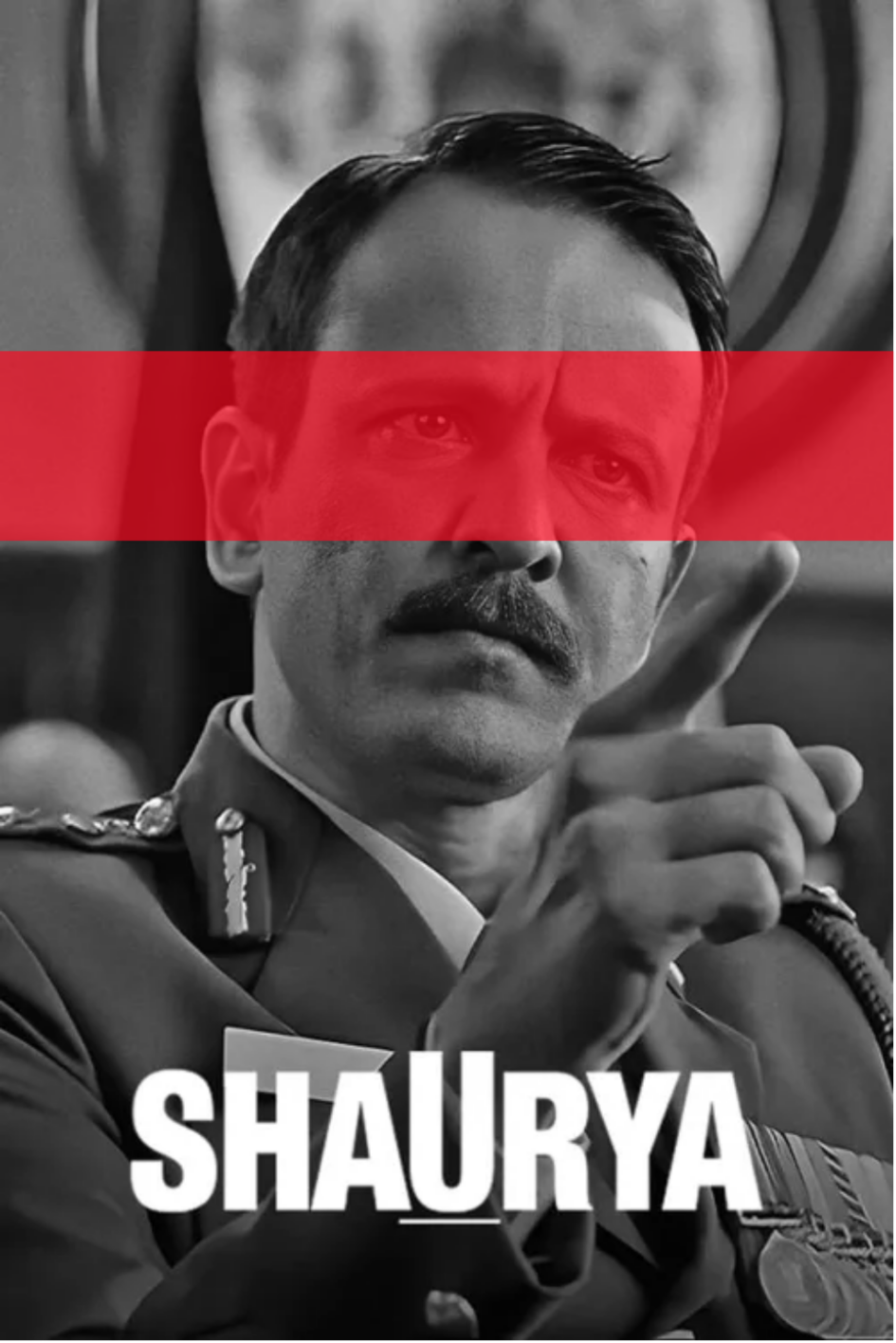
Law has always proved to be an interesting subject for films, providing a platform for directors to explore issues related to justice, power, and morality. However, because of cinematic constraints, the depiction of legal procedures is often adapted to cinematic requirements.
‘Shaurya’, set within the rigid and hierarchical framework of military justice, situates its narrative in the court-martial of a soldier where the trial is used as more than a mere setting for conflicts to arise; becoming instead a prism through which the functioning of the legal system within a command-oriented institutional setup comes into focus.
What is SHAURYA?
The preliminary question that arises is what the title of the film means. Etymologically, Shaurya is derived from the Sanskrit word “shaurya”, meaning ‘courage’, ‘bravery’, and ‘valour’. This concept of courage is positioned in the institutional context of the Indian Army through the central perspective of the military justice system. This movie does not position courage narrowly in the context of warfare but in the context of legal adjudication, command, and enforcement of authority as defined by the law.
The story revolves around the life of Major Siddhant Chaudhary, an Indian Army lawyer, who is tasked with the responsibility of defending Captain Javed Khan, a soldier who allegedly killed his superior officer, Major Virender Singh Rathore, while conducting an operation in Kashmir. Captain Javed surrenders himself before the authorities and admits to having pulled the trigger that killed the officer, making the case seem rather simple. Captain Javed faces the charge under Section 302 of the Indian Penal Code1, read along with Section 69 of the Army Act, 1950, such that an army officer can be prosecuted by court-martial for any crimes he commits in civil society. The trial of Captain Javed is conducted under the control of Brigadier Rudra Pratap Singh, who commands the operational area and appears rather unyielding.
As the court martial continues, Major Siddhant finds himself questioning the prosecution’s version of events, which meets resistance from higher officials and witnesses, such as the case of Brigadier Pratap Singh. Instances of improper investigation, uncooperative witnesses, and abuse of authority in the military organisation come to light. From being a question of individual guilt, the case begins to raise questions of responsibility within a military organisation. Issues related to the application of the rule of law with respect to a military structure emerge as the legal inquiry progresses.
Court-Martial: Concept and Cinematic Depiction
The court-martial isn’t just a background setting of the film; it is the heartbeat of the film. The court-martial is portrayed in the film as a harsh, orderly, and strictly regulated environment that operates as a parallel to the standard criminal justice system. A court-martial, established under the Army Act 19502, is designed to try army personnel for offences. In Shaurya, however, it operates as more than a mere judicial proceeding. The film emphasises its institutional separation from civilian courts, portraying it as a mechanism primarily concerned with discipline and order, alongside the administration of justice.
General Court-Martial, District Court-Martial, Summary General Court-Martial, and Summary Court-Martial are the four categories of courts-martial under the Act. Each varies in who is in charge, the types of offences it can try, and the gravity of the issues. These courts are empowered to try military offences and, in certain circumstances, civilian offences committed by army personnel.
Shaurya appears to depict a proceeding analogous to a General Court-Martial for serious offenses which is the highest and most serious form. A senior military officer presides over the formal, inflexible courtroom, which has a panel of officers on the bench. The process is similar to a standard criminal trial, even though it is in a military court. However, everything is done in accordance with military protocol and law. This internalised structure reinforces the ethos of discipline but simultaneously raises concerns about impartiality and institutional bias — tensions the film gestures towards but does not fully interrogate.
Critique
Despite the fact that the movie addresses a significant theme of military justice, its storytelling is primarily influenced by conventional cinema. Since it is a courtroom drama, like other films belonging to the same genre, the movie has extensively used emotive dialogue, plot twists, and some symbolic incidents that further the plot. This approach towards storytelling is generally associated with the simplification of complex judicial procedures observed in real courtrooms.
The courtroom representation in the film mirrors this focus on morality and ethics, more than on procedures and formalities. The court martials are depicted largely in terms of heated debates and encounters, without much focus on procedures and formal reasoning. The dialogues between the presiding authorities, panel members, and lawyers are scarce, and the decision-making process of the court is uninvestigated. The trial, consequently, revolves more around moral concerns of what is right and wrong, and moral culpability, rather than procedures and formalities, which again emphasises the theme of the film but makes the courtroom a stage for moral soapboxing more than an endeavour for legal accountability and the formal dispensation of justice.
More critically, the film’s climactic conviction of Brigadier Pratap under Section 302 of the IPC is legally untenable. His conviction rests almost entirely on his own confession, yet that confession pertains to broader moral culpability, not to the act of killing Major Rathore himself. Section 302 applies to the direct commission of culpable homicide amounting to murder. Charging Brigadier Pratap under this section, without addressing the question of which provision made his confession admissible as evidence in a court-martial proceeding in the first place, reflects a fundamental misreading of both criminal and military law.
The subplot involving journalist Kavya raises a different kind of concern. Her ability to move freely around an army camp in Srinagar, which is one of the most sensitive operational zones in the country, is treated as unremarkable by the film. While freedom of the press is a value worth defending, the depiction is at odds with the stringent access restrictions that govern high-security camps, particularly in active insurgency zones. The film does not engage with this lapse at all.
Several characters commit acts that carry clear legal consequences under the Army Act, yet the film ignores them entirely. R.P. Singh’s persistent non-cooperation with court martial proceedings, for instance, could have attracted liability under Section 59 of the Army Act, which specifically penalises failure to attend as a duly summoned witness or refusal to answer questions before a court martial. His obstruction passes without consequence.
Similarly, Captain Javed’s conduct warranted consideration under Section 41 of the Army Act for disobedience to a superior officer, in addition to whatever charges the film does briefly touch upon. The officers who provided false testimony, arguably the most corrosive act in any judicial proceeding, could have been charged with perjury under Section 60 of the Army Act. None of this is addressed.
Brigadier Pratap’s conduct during the dinner scene, where he openly intimidates Siddhant and draws explicit comparisons between himself and the supreme authority of the region, could also have constituted obstruction or intimidation of an officer of the law, a charge the screenplay conspicuously avoids.
Ultimately, Shaurya prioritises emotional impact over procedural accuracy. The film does not explain the court-martial system, its types, or the legal framework that governs it, which, if added, would have enriched the narrative considerably. A deeper engagement with how the army itself is attempting to address the systemic problem of fratricidal killings, rather than reducing it to individual villainy, would have made for a far more substantive film. For a film that positions itself as a courtroom drama rooted in military law, this is a significant lapse.
That said, credit is due where it is deserved. The film makes an unambiguous moral statement that communalism and personal bias have no place in the armed forces, and that the army’s foundational purpose is discipline and the protection of Indian citizens. This is reinforced by the judgment in Lt. Samuel Kamlesan v. Union of India (November 2025)3, which reaffirmed the accountability of army officers in human rights matters. The film’s depiction of the General Court Martial structure of five jurors presided over by a single presiding officer is also accurate. These are some small achievements, but they cannot fully compensate for the legal inconsistencies that undermine the film’s credibility as a serious examination of military justice.
Conclusion
Shaurya is, at its heart, a film more preoccupied with what is right than with what is legal, and it makes no particular effort to hide that. The courtroom it presents is not a faithful reconstruction of how a General Court Martial actually operates. Procedures are compressed, charges are misapplied, and entire avenues of legal accountability are left unexplored. By the standards of a legal textbook, the film falls short.
But perhaps that is not the right standard to hold it to. What Shaurya does far more effectively is force a conversation that civilians rarely know about: about how authority shapes evidence, how rank influences accountability, and whether discipline and human rights must always exist in opposition to each other. These are not small questions, and the film deserves credit for asking them loudly, even if it does not always ask them precisely.
Viewed strictly as a representation of military law, Shaurya is an inaccurate and arguably incomplete depiction. Viewed as a piece of popular cinema that uses the courtroom as a mirror of broader social drama around institutional power, loyalty, and justice, it is considerably more psychologically stimulating. It reminds us that justice in hierarchical institutions may never be purely procedural. It might be political, personal, and deeply vulnerable to the weight of a uniform.
By Divyansh Arha & Aarchi Kothari from 3rd Year B.A. LL.B. (Hons.), Faculty of Law, The Maharaja Sayajirao University of Baroda, Vadodara.
1 The movie was released in the year 2008, therefore erstwhile penal law clauses are referred; Contemporarily: The Bharatiya Nyaya Sanhita, 2023, Act No. 45 of 2023, sec. 103, (came into force on 1 July 2024).
2 The Army Act, 1950, Act No. 46 of 1950.
3 Samuel Kamalesan v. Union of India, 2025 SCC OnLine SC