
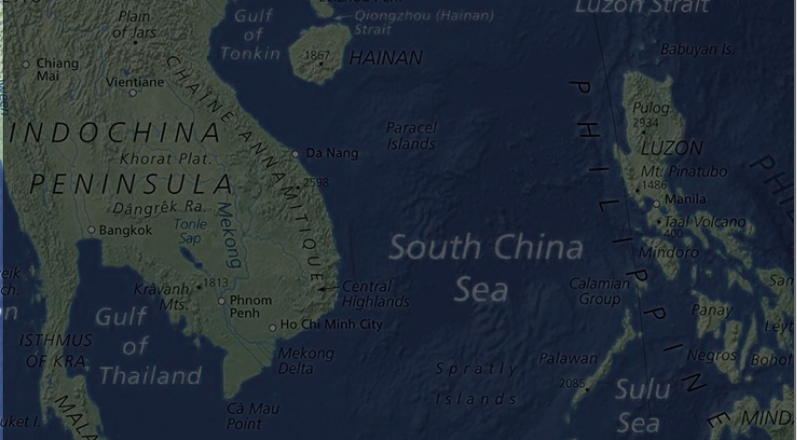
The South China Sea (SCS) has become one of the most contested maritime zones of the economy-driven world, shaped by overlapping territorial claims, militarization, and differential interpretations of international law. Located in Southeast Asia as part of the western Pacific Ocean, the SCS is bordered by China to the north; Taiwan and the Philippines to the east; Malaysia, Brunei, Indonesia, and Singapore to the south; and Vietnam to the west. It connects the Strait of Malacca with the Indian Ocean and the Formosa Strait to the East China Sea. The region includes prominent islands such as the Spratly Islands, the Paracel Islands, and Scarborough Shoal.
The primary source of dispute in this region is China’s expansive “Nine-Dash Line” claim, which was earlier known as the “Eleven-Dash Line” prior to 1949. It nearly covers 90% of the South China Sea. This traditional usage-based claim of China directly overlaps with the Exclusive Economic Zones (EEZs) of Vietnam, the Philippines, Malaysia, Brunei, and Indonesia, which are defined by UNCLOS.
Strategic Importance
The South China Sea is one of the world’s busiest maritime routes, central to global trade and connectivity in a trade-driven world. Approximately one-third of global maritime trade passes through this region, which is mainly known for major energy shipments and for the richest fisheries of the world, highlighing its importance for global economic dependability. The SCS contains valuable natural gas and crude oil reserves, making it a center for energy supply. These substantial resources increase the competition among states seeking maritime rights. China’s construction of artificial islands, equipped with radar systems, missile launch facilities, and airstrips, has shifted the regional balance of power between the claimants. The United States conducts freedom of navigation operations to maintain open sea lanes and to restrict the assertion based on power. The South China Sea, thus, plays a critical role in shaping global trade security, resource politics, and strategic military rivalry, expanding beyond a regional dispute.
Sovereignty Claims
Because of conflicting claims to sovereignty, the South China Sea is still a politically charged and legally debated marine boundary. Based on its historical application, where the Han Dynasty of China dominated the South China Sea, including the islands and Scarborough Shoal, and in spite of having no explicit legal standing under modern maritime law, China’s vast “Nine-Dash Line” spans 90% of the South China Sea. This historical claim causes a straight overlap of the Exclusive Economic Zones (EEZs) of several Southeast Asian countries under UNCLOS.
Based on the Geneva Accord assertions, historical governance, and records from the French colonial era, Vietnam asserts sovereignty over the Paracel and Spratly Islands. Malaysia asserts geography-based claims, including the Southern Spratly Islands, EEZs, and continental shelf entitlements. The Philippines and Brunei claim EEZs and continental shelves under UNCLOS. Though not a claimant to any island, Indonesia continually refuses Chinese incursions into its Natuna EEZ, where it encroaches. All claimants keep up patrols, construction, or resource exploration. Under UNCLOS, maritime rights stem from land characteristics and coastal geology. It directly contradicts worldwide legal rules because of a lack of broad historical claims.
International Law Framework
The main international rule regulating the South China Sea is UNCLOS. It lays out strict requirements for nautical rights and jurisdiction. UNCLOS gives sovereign rights over natural resources inside a coastal state’s Territorial Sea (up to 12 nautical miles), Contiguous Zone (up to 24 nautical miles), and, for this case, the Exclusive Economic Zone (EEZ), ranging up to 200 nautical miles. Straightaway contradicting China’s vast Nine-Dash Line assertion, which lacks a basis in the convention, while also overlapping with the EEZs of the Philippines, Vietnam, Malaysia, Brunei, and Indonesia, UNCLOS’s marine rights come from the landforms that support human habitation, survival, and economic existence. Though UNCLOS is a broad legal framework meant to prevent marine disputes, the conflicts in the South China Sea expose its flaws, such as diverse interpretations, rival claims, lack of customary practices, and, very importantly, weak enforcement measures.
Permanent Court of Arbitration, 2016
The 2016 Permanent Court of Arbitration (PCA) decision in South China Sea Arbitration (Philippines v. China) was a legal interpretative turning point in the conflict. The tribunal found that rights could not supersede the maritime zones created by the convention; China’s Nine-Dash Line had no legal force under UNCLOS. Most of the Spratly Islands were determined to be rocks or low-tide elevations by PCA, therefore reducing the marine entitlement since they do not meet the definition of “Islands,” and preventing the development of EEZs. The court also noted that China is infringing upon the Philippines’ sovereign fishing and oil exploration rights within Manila’s EEZ. The extensive island construction causes serious environmental harm. However, despite the legal clarity, China declared the tribunal’s decision as null and void. It also declined the result and withdrew from the adjudication process. The lack of an enforcement mechanism in UNCLOS demonstrates the inability of the world legal system to stand against the big-power countries. Though the award improves the legal standing of Southeast Asian plaintiffs, it nevertheless restricts them.
Militarisation and Hybrid Warfare
By turning disputed reefs into fortified strategic outposts, militarization in the South China Sea has increased. China’s massive island-building project includes Fiery Cross Reef, Mischief Reef, and Subi Reef; these have generated artificial islands fitted with airstrips, missile shelters, radar systems, and deep-water ports. These have extended China’s power projection capabilities across the region.
These installations allow for surveillance coverage, rapid deployment, and enforcement of China’s expansive maritime claims. This alters the regional balance of power in the waters.
Beyond the conventional militarization, China intimidates its neighboring states without triggering direct armed conflicts. These actions, which may include ramming, water-cannoning, or surrounding other vessels, take advantage of legal uncertainty about the role of civilian and paramilitary actors. The region also becomes a new arena for information warfare where the domestic and international opinions related to the sovereign position of the disputed region are moulded by digital propaganda, civilian computer narratives, cyber operations, etc. These are beyond the conventional militarization and are often known as hybrid Gray-zone tactics.
In response United States also conducted regular freedom of navigation operations to challenge the accessible maritime claims and establish the principle of open sea lanes under international law, as the United States is not a signatory to UNCLOS and EEZ. China also counters it with the anti-access and area-denial capabilities to neutralize these foreign military vessels and approaching aircraft. This shows collectively that the South China Sea has evolved into a laboratory for contemporary conflict apart from traditional militarization.
Economic and Environmental Pressures
Powerful states influence weaker claimants without resorting to direct military warfare in the South China Sea, which is termed economic coercion. China repeatedly pressurizes states such as the Philippines and Vietnam through trade restrictions, investment leverage, and market access to showcase the strategic value of its economic dominance. Constant competition for oil, gas, and fisheries triggers aggressive state behaviour in the disputed waters. The constant restriction and patrolling cause loss to the coastal communities whose livelihood depends on the sea.
Environmental damage further contributes to structural violence. Island construction has destroyed thousands of acres of coral reefs, which are vital breeding grounds for fish. This causes an imbalance of ecosystems and regional food security. The livelihoods of local fishermen who depend on the sea for subsistence and income are threatened due to militarised water and overfishing by distant-water fleets. Long-lasting suffering for the vulnerable coastal people comes not only from the armed conflict but also from the environmental disaster and economic emigration. Beyond the geopolitical arena, the South China Sea conflict extends to structural violence.
Weakening Multilateralism
The South China Sea controversy illuminates the flaws of regional multilateral organizations, especially the Association of Southeast Asian Nations (ASEAN). Although there is a requirement for collaboration and conflict prevention, ASEAN has not been able to maintain a consistent posture over the conflict. In 2012, internal disagreements stopped the release of a joint declaration–an unheard-of diplomatic failure. This failure causes institutional inertia as national interests vary and economic reliance on China rises.
This paralysis helps to explain why the rules-based world order of the area is failing. Existing instruments like UNCLOS lack adequate enforcement; moreover, ASEAN members’ inclination to question the assertiveness of major-power countries is seen in the 2016 Arbitration case. Preferring bilateral negotiations, which directly sidelines ASEAN and impedes coordinated conflict management initiatives, China aggravates this problem. These dynamic signals represent a move from collaborative legal standards to power-driven politics, resulting in a reduction in multilateralism, which had proven successful in resolving the South China Sea conflicts over bilateralism.
Conflict Management Options
Even when conflicts exist, there are several methods to reduce the clash and promote stability in the South China Sea. One such alternative is the establishment of joint development zones. These zones allow claimants to share resources like fisheries and hydrocarbon reserves without compromising the sovereignty claims. This alternative allows for cooperation while preventing the escalation of disputes in the waters. The Code of Conduct between ASEAN and China is another avenue for conflict management. This includes rules of behaviour to reduce the risk of miscalculations of region and create a mechanism for communication during maritime incidents or disputes. Although the progress in SoC institutionalised application is slow but effective, it also includes coordinated patrols, shared environmental monitoring hotlines, and contributes to reducing the potential tension by building confidence between the two.
Legal innovations and preventive diplomacy are important for the regional dispute settlement mechanism. This enhances the compliance with UNCLOS norms. It also encourages non-adjudication methods like mediations or arbitration to bridge the legal gap and manage the disagreement peacefully. Track 2 dialogues further support de-escalations but facilitate dialogues outside the formal political constraints in private by taking practical steps towards stabilizing the region. The ultimate sustainable conflict management, it seems, depends on cooperative frameworks that align economic and environmental interests, security, peace, and development across the claimant states.
Conclusion
The South China Sea controversy shows a complicated convergence of law, geopolitical rivalry, and power. Revealing how shaky International Maritime governance is, as a result of overlapping sovereignty claims and differing historical narratives, it stands as the most defining conflict of the 21st century. When a big power country, like China, refuses to comply, it shows the limits of International Maritime control. The 2016 PCA decision clearly specifies how legal outcomes have little impact because of the enforcement mechanism or the absence of political will. Militarization and hybrid warfare not only compromise regional stability but also the income of millions depending on the sea for their subsistence.
Moreover, the argument reveals the weak international framework. The internal division of ASEAN and China’s preference for bilateral interaction limit the extent of multilateral diplomacy. This caused a change from power-driven negotiation to rule-based order. And many conflict resolution strategies, including a joint development zone, a successful code of behavior between ASEAN and China, creative legal means, and confidence-building projects, could help to relieve strain and foster trust.
Ultimately, the South China Sea conflict rests on the capacity of the claimants to negotiate sovereignty with collaboration and power with fair constraints. This conflict reminds us that long-lasting peace calls on us to respect international law, embrace shared obligations, and sustain governance.
By Nandini Rastogi, 5th Year B. A. LL. B. (Hons.), Faculty of Law, The Maharaja Sayajirao University of Baroda, Vadodara.