
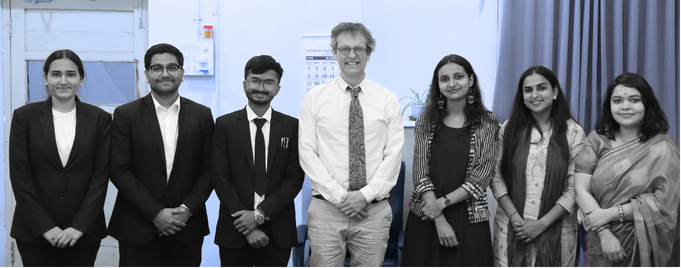
Q: Speaking about your career and education, you studied in Germany, Oxford, Harvard and have taught in various institutions like Max Planck and are currently a Professor at the University of Regensburg. What were the key moments in this journey and who were the key mentors that shaped your path into Public European and Comparative Law?I was always committed to working in academia which, in hindsight, was probably rather naive. But as a young person you may be naive, right? It turned out to be lucky enough and it worked out well. But it has always been my major professional path I was looking for. The fact that it worked out very much is a kind of a chain of lucky coincidences. If you get admitted to a prestigious institution the next one will be easier. There are a lot of fortunate coincidences involved as well. In terms of mentors, there have been many. The way German academic careers are being framed is that you need to write two monographs for your academic qualification which have supervisors. Of course, the supervisors of these two works were important for my development. And beyond that, many people I met, lectures I attended, and certain texts or books became formative. By and large, it is rather the variety of impressions and inputs that I got, and not one single thing. Moreover, I definitely want to emphasise the coincidental luck element in the entire thing.
Q: Much of your academic work has focused on citizenship, membership in political communities, and access to fundamental rights at multilevel systems. There has been a question of citizenship internationally, recently, and talks of the U.S. denaturalising its citizens. What piqued your interest in this specific topic and how have your views evolved over time, especially in the contemporary era?That is a difficult one. Citizenship, at some point in my academic work, proved to be an analytically useful concept while I was dealing with the matters of composition of political communities and how they manifest in the law. In an individualised legal culture, individual entitlement is linked to the concept of citizenship. This was an analytically useful concept for me at the time in order to juxtapose an analytically useful idea to its normative content.
I think the recent developments that you are referring to very much relate to some governments systematically ignoring the normative elements in that. I used citizenship, as I said, as a normative and analytical concept, as it was particularly necessary to deal with it because much of the related literature that I wanted to incorporate was using that concept. So it seems more prominent in my work than it might be in normative terms to myself.
I fully share your concern about what’s going on with regards to this because depriving people of their rights can take so many shapes and withdrawing citizenship is just one particularly striking, particularly far-reaching way of doing so. If you look into European history in particular, Hannah Arendt’s reflection of citizenship and the right to have rights, of course, it’s reminiscent of these dark periods and it’s sad to see that. I reflect on these as a sad development, but it doesn’t change my analytical perspective on the concept.
In the entire course of career, you have taken up multiple editorial roles in various journals, which have dealt with equality orientated policies, strategic litigation, etc. So, what trends in contemporary scholarship excite you? What I appreciate most about my job is I get to choose, at any point in my life, what I think is most interesting to work on. That’s the main privilege. It’s a high price one pays for embarking on that career but it also gives the freedom to choose the topics you dedicate your mind to for a while. In my case, it actually plays out in different fields of interest over time. So, for a long time, I was interested in cognitive science, the idea of human rationality and its deconstruction by recent science, and what it means for the law, which was entirely off-road of what I had been doing before. Another big change in my field of work or interest has been that I was very much into theoretical work. Never doctrinal, but theoretical work.
And for the last 15 years, this gap between law and reality, i.e. law in the books and law in practice, has struck me to an extent that I do a lot of work on access to justice and the reality of implementing rules, and so on. So, what fascinates me is that there’s always much more than what I could possibly be dealing with. But, to be more precise, in recent years, the implementation of rules and sociological conditions of implementing rules has been a headline of what has been the predominant theme in what I’ve been working on, which could also be changed.
Converging the theme of this edition with your recent interest in implementation of rules, what do you think about the implementation of international law when we are in the situation of literally inheriting a world in turmoil?I am very pessimistic about the mid-term and long-term prospects of international law. I mean, international law has always suffered from the lack of any kind of unitary power backing it up. And the fact that it has now become very visible and explicit that the key players in the world don’t endorse this set of ideas anymore, is a major blow to that system. I think the system will hopefully be able to restore trust in its functioning in order to ensure compliance. I mean, you only comply if you feel that others will also comply, right? And if the bindingness of a normative framework is being accepted, then to restore such trust will be a major task. As we discussed earlier, inheriting a world in turmoil is a very good phrase and it makes people of my generation, of course, feel bad because we are the ones who have passed that on to you. Everybody should be constantly thinking about how that can be preserved or restored and what would be the trajectories of such stabilisation. I mentioned the speech of the Canadian Prime Minister recently. But none of the trajectories that come to mind or that are prevalent in the discussions right now seem to be realistic.
You’re inheriting a world in turmoil.
You said the gaps are more visible now and the problems with the international law system are more visible now. Do you think that reflects a fundamental crack in the system or do you think that this is more of a wake up call and things might normalise again? Or do you think it's an opportunity for other alternative ideas to take over? I mean, I perceive it as a major crack. And whether it can be healed, I am not particularly optimistic when it comes to short-term or mid-term scenarios. Could it give way to or could it evolve into a new world order of a couple of hegemonic systems and their peripheries, etc.? Conceivable, right? I think we would probably do better with the old destabilised order than any of the alternatives that I see coming up on the horizon right now. A few years back, people were very hopeful that there could be major reform in the decision-taking procedures of the United Nations when they saw the blockages coming up in the Security Council becoming so evident and the General Assembly playing a stronger role. People said that it could be the beginning of a new era of reshaping decision-making. Because we found out that the Security Council was the kind of institutionalisation one could get after World War II, but it’s not ideal. But, how do you get from there to a new, better one? And bringing that up, people were optimistic when they saw that the General Assembly would, by coming up with resolutions on issues that might replace or oppose the blockage in the Security Council, assume a stronger role and lead to a new institutional setup there. So things can change, right? I mean, maybe in two years’ time, the conditions might be better. You can also hope for counter-reactions. If we talk about the European Union, the main hope that rests on it is to restore its position or to live up to the expectations and counter reacting to the external challenges. So there are always narratives of optimism that are conceivable. And even if the tone of the time is rather pessimist, one should be aware of the fact that times change.It’s only a few years back that there were more optimistic narratives. And we might get there again. Who knows, right?
As you work on a lot of Fundamental Rights Protections in a multi-level system, and on questions of constitutional identity within the European Union, how well do existing European and international institutions cope with overlapping crises? And where do you see the greatest need for doctrinal or institutional innovation? So, we did have COVID, of course, and the financial crisis. They don’t deal well with the European institutions. But it depends on what the yardstick is and what you compare it to. Let us take the climate issue or environmental policy. In a world of nation-states, you cannot tackle the issue because it’s clearly a trans-border problem. So, anything that you can achieve in terms of trans-border cooperation is a benefit. And the European Union clearly provides the maximal platform for such cooperation. The European Union does have decent climate policies, better than any other international corporation would have come up with. So. the European Union is performing badly if compared to the expectations, But it Is not performing badly if compared to a world or Europe with only nation-states and no such institutionalisation. When it comes to migration, probably a similar argument could be made about that. But migration is a good case to illustrate the weaknesses or the structural challenges within the European Union. We do have dramatically different interests among the nation-states in the European Union. Those countries which happen to have a coastline to the Mediterranean are the ones where the refugees arrive first. But how do you agree on a change if all those not on the coastline wouldn’t benefit from such a solution? Plus, the attitudes towards migration policy differ sharply between Eastern European countries. Central European and Western European countries are somewhat more open towards that. I mean, there would be an easy way to find a fair solution. You distribute the burden and you might have a compensatory scheme, money-wise. Some countries would rather pay than accept more foreigners. In a way, this is what everybody said. It has now been more or less achieved. But it took ages. That’s the other thing within the European Union. Making sure that everybody agrees to what has been agreed upon, and everybody really lives up to their promises, is an issue still. So, migration is a clear showcase of how decision-making in the European Union would not enable that institution to tackle some problems where there have very disparate interests. Will it be able to reform its decision-taking procedures to an extent that it will be more effective in that way? First of all, the question is whether it’s desirable, because centralisation will mean that these central players, specifically the member states, will lose political authority in some areas. And when it comes to the issue of participation and moving up one level higher. It makes it harder for the individual to really have their say in politics. So it would come at a price. And the other question is, would one ever get there? I mean, will they be able to, because structural fundamental constitutional change within the European Union would need general consensus by all member states. Moreover, has the European Union been able to deal with the overlapping crisis? I think the financial crisis was handled better with than without the European Union. The climate or environmental policy is handled better with the European Union than without. Migration and COVID, I am in doubt. In all these cases, you see the limitations but also the potential and discontent.
Many people opine that the global instability and lack of interest in solving the climate crisis serves moneyed interests. Do you think an alternative economic model is the answer to these questions? If so, how much or what model do you think might help? What would be an alternative economic model?I think the devastating current situation with regard to the policy challenges that you mentioned could be addressed, maybe even cured by a market economy system that is being carried out according to its own aspirations. The growing inequality in highly industrialised societies, the tech billionaires in the US, etc., that is a clear malfunctioning of a market economy. No one ever thought of such a thing to be the desirable outcome. Market economies need to be hedged in rules and of course you have to prevent such outrageous developments and effects. To respond to the environmental challenge that you mentioned, a system that enables the pursuit of economic interest and self-interest, might run into difficulties with regard to all externalities, particularly environmental externalities.
But again, it is visible within a nation state setting that you can have regulatory responses. You internalise external costs, you prohibit by regulation what cannot be internalised and what cannot be accepted. I do see that we have a major problem in a globalised economy without a globalised government capacity in responding to these market deficiencies that need regulation as a response. It would be highly desirable to establish government capacity that manages or enables us to regulate markets the way they need to be regulated, in order not to lead to these major externalities, problems or accumulations.
How can Germany and India, and probably other globally acting parties work together and learn from each other to have an optimistic approach in the upcoming years and move away from the pessimistic reality which we are currently facing?I mean, we all know what needs to be done, in terms of economic sustainability and so on. The problem is, can we agree on who’s going to sacrifice what for that? I think hope rests in your generation. And what do we need? We need to get a common understanding of the problems and an understanding of the commonality of the problems that we have. So, we need to understand each other better, be in contact more. This is certainly the basis for developing trust. And it is also a necessary precondition for finding out what common next steps would be realistic. This recent agreement between the European Union and India to cooperate more, I think, was a very promising step. Cooperation certainly is important. Learning about the challenges in such cooperation, I think it can only be promoted by more interaction. So, I wouldn’t know where Germany and India or Europe and India should exactly go forward and in which areas. But I think laying the foundations for that is really important, and then find out how we can go forward.Laying the foundations means getting into an exchange, learning about each other’s problems, and building trust.
When you speak to young law students, what advice would you want to give them to make a meaningful career in the future? I like your question and I particularly like the issue of a ‘meaningful’ career-the attribute. For me, dedicating so much of your time to teaching, indulging in the advantages of my job, the freedom in research, I feel is great. But I do and have struggled a lot with this thing, i.e. do I want to teach people the stuff that the system requires me to teach them? In Germany, our legal educational system is extremely standardised and formalised. We create a generation of high-skilled technicians. The exam format is such that they have to get so much stuff into their head that they don’t really have the freedom to think about anything else. What needs to be internalised is that which will be checked in the exam, and that’s the formalised technical stuff. So for me, it has for long been an issue. Do I want to dedicate to and accept the system? I actually even think it’s probably beneficial to society to some extent to do it that way. But do I want to dedicate my time conveying that? I don’t have an answer to that, but the approach that I found in dealing with that is trying to introduce the other perspective to students, by helping them see that law is a tool to do something meaningful and good.
Most academic careers don’t look like that. When I studied in the US, a professor told me about the metaphor of the golden elevator. You get into a top US law school, you pay high tuition, you are highly indebted afterwards because you can’t pay for that, and you have to enter a corporate law firm afterwards in order to pay your study debt. And then you’re socialised in the corporate world and then you remain there. This is not what should happen, right? We don’t have that issue of students running into high debt after the course. But socialising them the way we do, we still no not have the golden elevator, but some pull into that direction is there. So, I think the most important thing is to keep this other perspective, to have the critical perspective and ask yourself what is important and what do I want the effect of law to be in society. We might still disagree on what are good causes and bad causes, etc., and we might disagree on what the best way of career trajectory is. You might run a corporate career and do good. But to instill the question in people’s minds – will I find meaning in what I’ve done? Probably, a good perspective is looking back at what you have done.
You have experienced the German educational system and, to some extent, the Indian institutions. What do you think we can also learn from each other in terms of institutional frameworks or how we offer legal education?Firstly, German legal education is too technical and too inflexible. I was asked what the big topics are in German legal education. I had to respond that we have big topics and then we have legal education, but they are separate. Secondly, we find interactive modes outside the formal conveying of content. The programmes that India has, like the outreach programmes, manages to offer something beyond that. I mean, I saw this experience this year and it’s very difficult to get this going at our end. So these would be the two most obvious lessons. The other way around, I don’t think I could suggest what India could learn from the German system. The canonisation of the field of science is extremely advanced in Germany, but that’s not something that one can adopt. I think we have a redundantly high number of legal authors. We have 80 million people and 15 commentaries on our basic law and our constitution. A lot of scholarship going into that. So for each subject that you read here, you would have five to seven standard textbooks. So there’s huge canonisation of that, and that is an asset. So people who have studied law in Germany in very different places will have a very similar mindset because they’re really exposed to a very standardised common field of knowledge.
Sir, you have been in academia for years now. What is the one question that you have been repeatedly asked and one question that you want people to ask you, but haven't had the opportunity to be asked yet? Very often or too often, a set of questions that I’m being asked very often is how to approach legal studies, what to place most emphasis on and how to acquire the necessary knowledge. I mostly tell people to find their own way because it’s so individual. I fully understand that and I struggle the same way. But I believe that we can’t really provide a one-size-fits-all approach to that. That’s the thing that I find most difficult to respond to.
And the other one I have to think about. In the German system, I would love for people to invite me to talk more about what I dislike about the system, what could be different or what would be the alternative counter-model. To have the alternative image, I would love for people to be more interested in what it would look like if it were entirely different. But I’m never asked about that.